Skip to content

small-restaurants

5 posts with the tag “small-restaurants”

Leanpath alternatives for small restaurants: simple food waste tracking

Food waste tracking in commercial kitchens has historically been split into two extremes: manual clipboard paper logs that get ignored, or heavy enterprise systems designed for university dining halls and hotel buffets. Leanpath is the most prominent name in the latter category, but small independent restaurants, bakeries, and cafes often require a different approach.

The enterprise approach: what is Leanpath?

Leanpath is an enterprise-grade food waste prevention platform. It relies on a combination of hardware and software:

  • Floor scales and table-top scales: Kitchen staff weigh every bin of food waste before discarding it.
  • Integrated cameras: The scale systems take photos of the food waste to verify what is being thrown away.
  • Touchscreen terminals: Staff select the reasons for waste (spoilage, overproduction, trim waste) on a mounted tablet.
  • Enterprise cloud analytics: Managers receive dashboards showing waste patterns across multiple corporate locations.

This system is highly effective for high-volume foodservice operations (like hotels, hospitals, and universities) where reducing waste by even 1% translates to tens of thousands of dollars. However, the hardware footprint and subscription costs make it complex to deploy for smaller independent operations.

The challenges for small kitchens

For a small independent kitchen or neighborhood cafe, an enterprise scale-and-camera system introduces several friction points:

  1. Space constraints: Small kitchens rarely have room next to their garbage bins or prep tables for a dedicated, permanent weighing station.
  2. Speed of service: In a busy, understaffed kitchen, requiring staff to weigh, photograph, and categorize every single trim or leftover item can slow down prep and cleaning shifts.
  3. Upfront hardware cost: Purchasing or leasing commercial scales and camera-mounted terminals represents a significant capital expenditure.
  4. Data fatigue: Tracking 300 different ingredients often leads to messy data that is difficult for a busy owner-operator to analyze.

Simple alternatives for small restaurants

If an enterprise hardware system is not a match, small restaurants typically use one of three alternative methodologies:

  • Paper logs with a focused item list: Instead of tracking everything, staff only write down waste for the top 5 high-cost or high-volume items (e.g., croissants, avocados, milk).
  • Digital spreadsheets: A shared tablet with a simplified Google Sheet or Excel form allows managers to enter weekly or daily waste counts.
  • POS sales-driven forecasting: Analyzing sales trends to adjust prep quantities before the food is even cooked, preventing waste at the source rather than just logging it.

If you are looking for a simple, hardware-free tool to track high-waste items and auto-generate daily kitchen prep schedules from your POS sales reports, FoodSaver offers a lightweight, budget-friendly alternative.
Toast vs Square for small restaurants: POS data and prep planning

Choosing a Point of Sale (POS) system is one of the most critical decisions for a small food and beverage business. Toast and Square are the two dominant platforms in the independent restaurant space. While both process payments and send orders to the kitchen, their reporting structures, export capabilities, and how they assist in daily prep planning differ significantly.

Square POS: simplicity and low barrier to entry

Square is famous for its ease of use and zero monthly fee software option. For small bakeries, pop-ups, and coffee shops, it represents a straightforward solution:

  • Hardware flexibility: Square runs on iPads, iPhones, and proprietary registers, with affordable plug-in readers.
  • Flat-rate pricing: Pay a percentage of card transactions, with no monthly base software fees for the standard tier.
  • Simplified reporting: Square provides high-level sales summaries, item sales reports, and basic category breakdowns.

However, Square’s CSV exports are relatively flat. If your menu relies heavily on complex modifier configurations (e.g., customized breakfast sandwiches, espresso drink options), analyzing how modifiers contribute to ingredient usage in Square requires manual work.

Toast POS: built specifically for foodservice

Toast is designed from the ground up for restaurants, cafes, and bakeries. It does not serve retail shops or beauty salons. Key aspects include:

  • Advanced table and menu management: Built to handle complex coursing, seat numbers, and kitchen display screens.
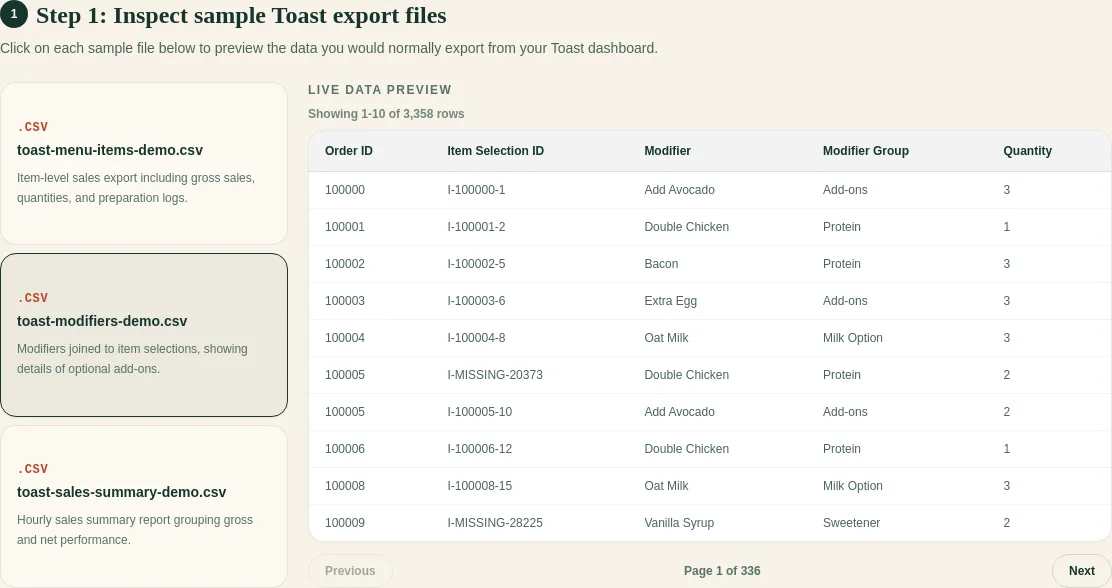
  • Detailed item and modifier separation: Toast exports distinct files for Item Selection Details and Modifier Selection Details, allowing operators to track exactly which modifiers were sold with which items.
  • Granular PMIX (Product Mix) reports: Provides deep insight into sales by hour, day of the week, and kitchen station.

The tradeoff is pricing. Toast typically carries monthly software subscription fees per terminal, plus hardware setup costs, making it a larger financial commitment for an early-stage kitchen.

POS data and daily kitchen prep

Neither Toast nor Square natively generates a dynamic kitchen prep sheet telling your prep cooks exactly how many units of an item or modifier to prepare each morning based on current inventory and waste logs. To do this, owners must export sales CSV files and manually compute the math in a spreadsheet.

If you want to turn your Toast or Square sales export CSV files into a clean daily prep plan and track high-waste inventory items without setting up complex software, FoodSaver offers a lightweight, budget-friendly tool to automate the process.

xtraCHEF vs FoodSaver for small kitchens: AP automation vs quick prep

Independent restaurant operators looking to optimize their food costs often evaluate inventory and kitchen management software. Two options that serve very different operational scopes are xtraCHEF (by Toast) and FoodSaver. Understanding their differences is essential for choosing the right tool without over-complicating your kitchen workflows.

xtraCHEF: the full back-office suite

xtraCHEF is a comprehensive back-office platform designed for medium-to-large restaurant groups. It focuses on accounts-payable automation and full inventory control:

  • Accounts Payable (AP) automation: Scan paper invoices with OCR technology to automatically log prices and sync them with accounting software like QuickBooks.
  • Recipe costing: Dynamically track how ingredient price fluctuations affect the cost of individual menu items.
  • Theoretical inventory: Track exact food usage by linking raw ingredient shipments to POS sales to calculate theoretical vs. actual waste.

While powerful, xtraCHEF requires a significant time commitment. Staff must scan every single invoice, keep recipe ingredient weights accurate, and conduct regular physical inventory counts for hundreds of raw ingredients.

FoodSaver: prep planning and key item tracking

FoodSaver addresses a different problem: the need for a simple, fast workflow that busy kitchen staff can actually maintain without heavy administrative overhead.

  • POS export preprocessing: Automatically parse and format raw sales exports from Toast or Square.
  • Key item tracking: Focus inventory counting only on the 10 to 30 high-waste items that drive daily prep and ordering decisions (e.g., proteins, baked goods, prepared sauces).
  • Daily prep schedule generation: Use current inventory levels and historical sales trends to auto-generate daily prep and bake targets.

FoodSaver does not scan paper invoices, manage accounts payable, or calculate plate-level recipe costs. It is built strictly to prevent overproduction and spoilage on a shift-by-shift basis.

Comparative summary

Workflow FeaturextraCHEFFoodSaver
Invoice OCR & AP syncYesNo
Recipe costing & plate marginsYesNo
Raw ingredient stock countsHundreds of items10-30 key items
Daily prep list generationNoYes
Setup timeWeeksMinutes

If you need a simple tool to track your highest-waste items and turn Toast or Square POS reports into automated daily prep sheets without the overhead of a full back-office system, FoodSaver provides a lightweight, focused alternative.

MarginEdge alternative for small restaurants: full platform or focused workbook?

MarginEdge and FoodSaver solve problems at very different depths. MarginEdge is a broad restaurant management platform. FoodSaver is a focused Toast export cleanup and workbook tool.

The problem

“MarginEdge alternative” can mean “I need another complete back-office system” or “I do not need a complete back-office system yet.” Small restaurants should separate those questions before comparing monthly prices.

What MarginEdge includes

MarginEdge’s official pages describe invoice processing, bill pay, inventory, recipe management, price alerts, ordering, daily reporting, and comparisons of purchases, sales, inventory, and waste.

Its public pricing page listed $350 per location per month for MarginEdge and $500 per location per month with the Freepour bundle when reviewed on June 23, 2026. The same page notes additional Toast subscription requirements for Toast API integrations. Verify current pricing and terms directly before purchasing.

What FoodSaver includes

FoodSaver handles a narrower workflow:

  • select supported Toast CSV exports;
  • preview and confirm file types;
  • confirm required columns;
  • create exact item-modifier joins;
  • keep exceptions and source references visible;
  • generate an Excel workbook for review.

It does not process invoices, pay bills, maintain inventory, manage recipes, or calculate a daily P&L.

Example Toast CSV columns

item_selection_id,business_date,item_name,quantity,net_price
item-204,2026-06-22,Burger,1,10.00

This is enough to begin an item-level sales review. It is not enough for actual food cost, because that requires purchasing, recipe, inventory, and waste data.

Decision table

Primary jobBetter fit
Invoice capture and codingMarginEdge-class platform
Bill pay and accounting syncMarginEdge-class platform
Inventory and recipe managementMarginEdge-class platform
Purchase-versus-sales usage analysisMarginEdge-class platform
Clean Toast exports into ExcelFoodSaver or manual Excel
Validate a recurring cleanup workflow cheaplyStart focused

The larger platform may be better value when several modules replace real labor. The smaller tool may be better when only one annoying workflow has been validated.

Screenshot and demo

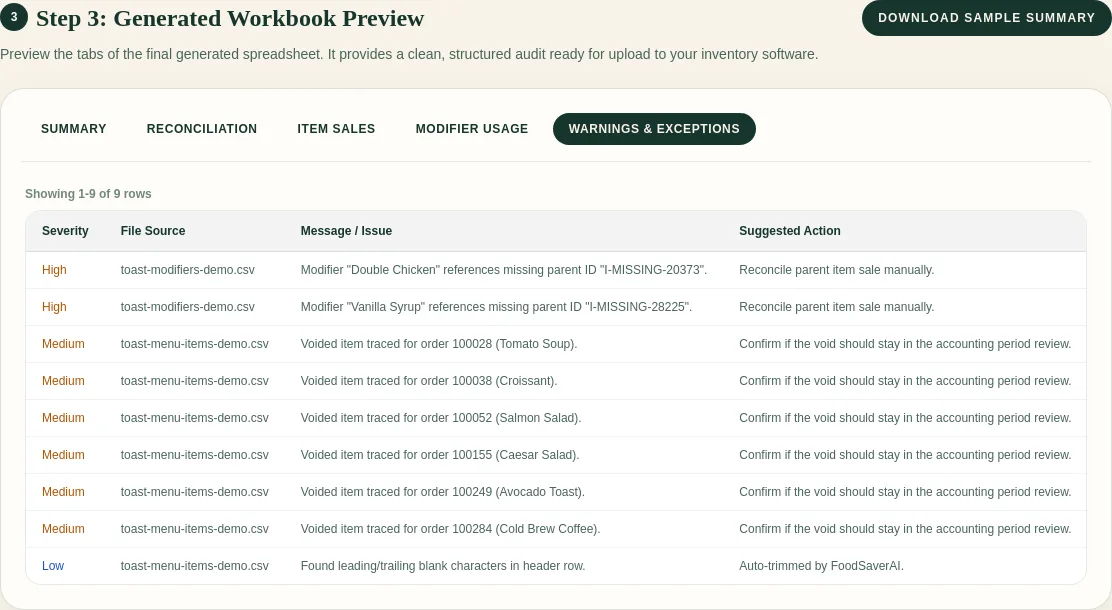
FoodSaver workbook exception preview with synthetic Toast rows

Open the FoodSaver demo to test the narrower workflow before treating it as a platform comparison.

Free sample workbook

Pricing

FoodSaver includes three free successful generations per UTC day within free limits. Pro is $19/month or $190/year. MarginEdge’s official page listed the per-location prices above as of June 23, 2026; confirm current pricing and integration costs with MarginEdge.

See FoodSaver pricing.

Frequently asked questions

Is FoodSaver a MarginEdge replacement?

No. It replaces only a narrow manual export-cleanup task, not the broader back-office platform.

Which is better for inventory?

MarginEdge documents inventory, recipe, purchasing, and usage capabilities. FoodSaver does not currently provide inventory management.

Why compare them at all?

Because a restaurant searching for an alternative may be deciding between a full system and a smaller validated workflow, not between identical products.

Can Toast CSVs produce actual food cost?

Not alone. Actual food cost needs purchases and inventory; theoretical usage also needs maintained recipes and PMIX mappings.

Sources

Also compare the xtraCHEF alternative decision.

Try the free Toast Prep + OneCSV workbook generator.

xtraCHEF alternative for small restaurants: when a workbook is enough

FoodSaver is not a feature-for-feature replacement for xtraCHEF. It is a lighter option for a narrower job: turning supported Toast CSV exports into a reviewable Excel workbook.

The problem

A small restaurant may search for an xtraCHEF alternative for very different reasons:

  • it needs invoice automation and inventory management;
  • it wants recipe costing and actual-versus-theoretical analysis;
  • or it simply needs cleaner Toast sales and modifier files this week.

Those are not equivalent buying decisions.

What xtraCHEF is built to do

xtraCHEF’s official product pages describe a broad restaurant back-office platform: accounts-payable automation, invoice capture, inventory, recipe and plate costing, price tracking, purchasing, and sales/PMIX analysis. Public pricing is handled through a request form at the time of this review on June 23, 2026.

Choose that class of platform when invoice and inventory workflows are the actual problem and the team will maintain the required operational data.

What a lightweight workbook workflow does

FoodSaver currently:

  • accepts Item Selection Details and supported optional Toast exports;
  • asks you to confirm columns;
  • joins modifiers only through exact identifiers;
  • creates clean item, modifier, reconciliation, and exception views;
  • preserves supported optional files as source sheets;
  • leaves accounting and operational decisions to the reviewer.

It does not scan invoices, manage inventory, calculate actual-versus- theoretical food cost, or replace accounting integrations.

Example Toast CSV columns

item_selection_id,business_date,item_name,quantity,net_price
item-204,2026-06-22,Burger,1,10.00

For the narrow workbook workflow, those item-level fields plus exact modifier parent IDs matter more than a full back-office implementation.

Decision table

NeedBetter fit
AP automation and invoice codingxtraCHEF-class platform
Inventory and recipe costingxtraCHEF-class platform
Actual vs theoretical usagextraCHEF-class platform
Clean Toast item/modifier workbookFoodSaver or a manual Excel process
One-off export cleanupStart lightweight
Multi-location back-office standardizationEvaluate a full platform

Screenshot and demo

FoodSaver Toast workbook preview using synthetic data

View the public demo before deciding whether the narrower workflow solves enough of the problem.

Free sample workbook

Pricing

FoodSaver provides three free successful generations per UTC day within free limits. FoodSaverAI Pro is $19/month or $190/year. xtraCHEF asks visitors to request pricing; verify the current quote and included modules directly.

See FoodSaver pricing.

Frequently asked questions

Is FoodSaver a full xtraCHEF replacement?

No. FoodSaver covers a much narrower export-cleanup and workbook job.

Which option is better for invoice processing?

xtraCHEF’s documented scope includes AP automation and invoice capture. FoodSaver does not.

When should I start with a spreadsheet workflow?

When the immediate recurring pain is a small, defined file-cleanup task and you have not validated the need for a full back-office platform.

Is xtraCHEF only for Toast restaurants?

xtraCHEF says it can serve restaurants beyond Toast, while some advanced benefits are recommended with Toast.

Sources

Also compare the MarginEdge alternative decision.

Try the free Toast Prep + OneCSV workbook generator.